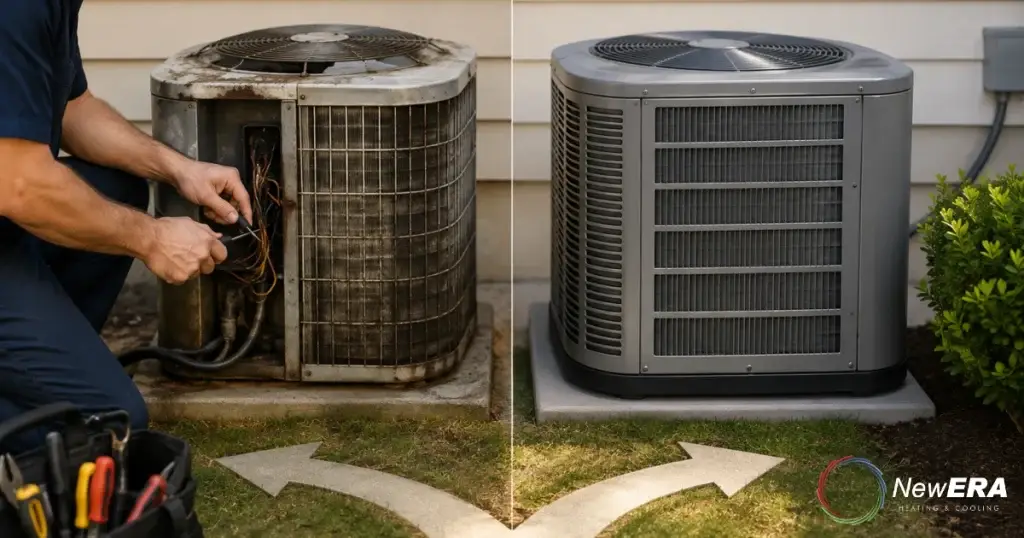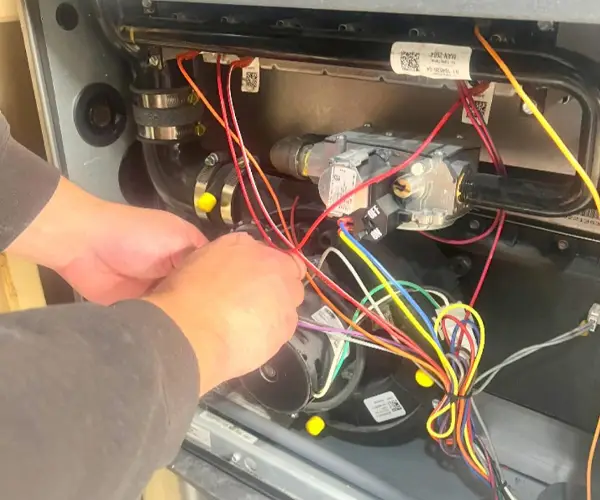
The short answer: A furnace tune-up is a yearly checkup to make sure your furnace is running safely, efficiently, and ready for the heating season. At New Era Heating & Cooling, that means checking the furnace’s safety components, electrical parts, burners, blower, gas pressure, airflow, thermostat, filter, and venting, then running the system through a heating cycle to make sure it is heating properly. It is not a repair. Its job is to catch small problems, including the ones you cannot see or smell, before the first cold snap turns them into a no-heat call.
Now the longer version.
Every fall, the same thing happens. The first cool morning shows up, you bump the thermostat over to “heat,” and you hold your breath a little while the furnace thinks about it.
Then it kicks on, the house warms up, and you decide the tune-up can wait another year.

We get it. “Tune-up” sounds like one of those things a company says to get a truck in your driveway. So here is the honest version: what a furnace tune-up actually is, what our technician does while they are standing in front of your furnace, and how to decide whether it is worth it for your house.
First, what a furnace tune-up is not
It is not a repair. If your furnace is dead, short cycling, or tripping the breaker, that is a service call, and you should just call us at (417) 732-8400.
A tune-up is the appointment you schedule before you need your furnace, usually right as the season changes from summer to fall. The whole point is to catch the small stuff while it is still small, before it turns into a no-heat call on the coldest night of January. (Furnaces have a sense of humor about timing.)
One more thing it is not: optional, according to the people whose job is consumer safety. The U.S. Consumer Product Safety Commission’s guidance is blunt: “Every year, have a professional inspect all fuel burning heating systems including water heaters and furnaces.” Your gas furnace is a fuel-burning heating system.
What our technician actually checks during a heating tune-up
Here is the heating tune-up we do at New Era, in plain English. The four big ones first, then the full checklist.
1. Burner and ignition check
Your furnace lights itself over and over, all heating season long. We make sure the igniter and flame sensor are healthy, the burners light cleanly and evenly, and the flame looks the way it should. A lazy or dirty burner wastes gas and is one of the most common reasons a furnace starts acting up mid-winter.
2. Heat exchanger inspection
This is the part of the tune-up we care about most. The heat exchanger is the metal wall between the flame and the air that blows into your house. Over years of heating up and cooling down, that metal can crack. When it does, combustion gases, including carbon monoxide, can mix with the air you breathe. You cannot see a hairline crack from the outside of the furnace, and you cannot smell carbon monoxide at all. This inspection is the single biggest reason the annual professional check exists.
3. Gas pressure and safety checks
Furnaces are built to shut themselves down when something is wrong. We test the safety switches and controls that do that job, and we confirm the gas pressure is where the manufacturer wants it. Too little and the furnace struggles. Too much and you are wasting fuel and stressing parts.
4. Blower, electrical, and filter
We check the blower motor, wheel, and capacitor, test the electrical side (wiring, connections, voltage, and the control components), and check the filter and tell you if it is due. Weak electrical parts are the kind of thing that fails on a Sunday night.
The full checklist
A New Era heating tune-up typically covers:
- Safety check: inspect the heat exchanger, burners, venting, and other components for potential safety concerns.
- Burner and ignition inspection: check the burners, igniter, and flame sensor for proper operation.
- Blower inspection: check the blower motor, wheel, and capacitor and verify proper operation.
- Electrical check: inspect wiring, connections, voltage, and control components.
- Gas pressure check: verify the furnace is receiving the proper gas pressure.
- Temperature and airflow check: check the temperature rise and make sure the system is moving air properly.
- Thermostat check: verify the thermostat is communicating properly with the furnace.
- Filter inspection: check the filter and let you know if it needs to be replaced.
- Condensate inspection: check the drain and safety components on high-efficiency furnaces.
- Venting inspection: check the flue and vent system for proper condition and operation.
- System test: run the furnace through a full heating cycle to make sure everything is working properly.
If we find something during the tune-up, we tell you what it is, what it costs to fix, and whether it can wait. No surprises.
Have a heat pump or an electric furnace instead of gas? The checklist looks a little different (there are no burners or gas lines to check), but we do fall maintenance on those too, and it matters just as much. Just let us know what you have when you call.
About “the smell of fall”
If the first time you turn on the heat you get a dusty, slightly burnt smell from the vents, you are not alone. Around here we call it the smell of fall. It is usually normal: dust settles on the heat exchanger and burners over the summer, and the first heating cycle burns it off. It should fade within an hour or so with the heat running. A smell that sticks around, or one that is sharp like burning plastic or hot wiring, is a different story. Turn the system off and call us.
What you can do yourself (and what you should not)
You do not have to wait for us to do the easy stuff.
- Check the filter every month during heating season. ENERGY STAR’s advice is that filters “should be checked every month, and changed at least every three months, or whenever the filter looks dirty.” If you want the long version, including why a 1-inch filter and a 4-inch filter are on different schedules, we wrote a whole post on it: Filter Math: How Often Should You Actually Change Your HVAC Filter?
- Clear the area around the furnace. Boxes, paint cans, and holiday decorations do not belong up against it, and nothing should be stored in the mechanical closet where the furnace and water heater live.
- Test your carbon monoxide alarms. Press the button. It takes ten seconds. The CPSC recommends CO alarms “in hallways near bedrooms in each sleeping area.” If you do not have one there, that is a good fall purchase.
- Set a sane thermostat schedule. A programmable or smart thermostat that turns the heat down while you are at work or asleep costs almost nothing to run. ENERGY STAR’s field data puts the savings from a certified smart thermostat at about 8% of heating and cooling costs, or roughly $50 a year for the average home. If you are a City Utilities customer, check their current rebates; a thermostat rebate is on the list as of this writing. We install Honeywell Home thermostats if you want one that just works.
What you should NOT do: open up the furnace, mess with the gas valve, or poke around the burners. Leave the furnace guts to us!
So, is a furnace tune-up worth it?
Here is the case, with no sales voice.
It is safer. The heat exchanger inspection is the one thing on this list you cannot do yourself, and it is the one that matters most.
It usually costs less over the season. ENERGY STAR’s maintenance guidance: “Keep your cooling and heating system at peak performance by having a contractor do annual pre-season check-ups.” A clean, properly adjusted furnace burns less gas to do the same job, and a tune-up usually costs less than an emergency service visit plus the repair that comes with it. Emergency calls are the expensive kind.
It can protect your warranty. Manufacturer warranties generally do not cover failures caused by neglect. Rheem’s residential limited warranty, for example, excludes “failures resulting from failure to properly install, operate or maintain Covered Equipment in accordance with the Manufacturer’s instructions.” If your furnace is still under warranty, a yearly tune-up (and the invoice that proves it) is cheap insurance on a very expensive part.
It buys you peace of mind for the season. You go into winter knowing someone who does this every day has looked at the whole system, not just the part you can see. New Era’s owner, Bryan Swanson, is NATE-certified and holds a Master Mechanical license, and that is the standard our technicians work to.
When it is not worth it: if your furnace is 20-plus years old, rusted, and already limping, a tune-up might just confirm what you suspect. In that case, read our Repair or Replace post first, or just ask us, and we’ll be straight with you about your options.
When to book a furnace tune-up in Springfield and Republic, MO
The best time for a heating tune-up is before you actually need the heat: late September through October in Springfield and Republic. Once the first cold snap hits, every HVAC company in town is running on no-heat calls, and tune-ups get pushed.
Book it now, and you will have it done while it is still hoodie weather.
You can book a one-time tune-up, or ask about an annual service agreement, which covers both your fall heating and spring cooling maintenance visits so you never have to remember to schedule either one.
Schedule your fall furnace tune-up or give New Era a call at (417) 732-8400. We serve the greater Springfield and Republic, MO area, and if something goes wrong before we get there, we offer 24/7 emergency service.
Furnace tune-up FAQ
How often should a furnace be serviced?
Once a year, before heating season. That matches the CPSC’s recommendation for all fuel-burning heating systems and ENERGY STAR’s advice to have a contractor do annual pre-season check-ups.
What is the difference between a furnace tune-up and a furnace inspection?
Mostly the name. An inspection looks; a tune-up looks and adjusts. New Era’s heating tune-up includes the full inspection (safety, burners, heat exchanger, electrical, gas pressure, airflow, thermostat, filter, condensate, venting) plus cleaning and adjustments where they are needed, and a test run at the end.
How long does a furnace tune-up take?
There is no set time. It depends on the condition and age of the equipment and on whether we find anything that needs attention during the visit. If something needs a closer look, we tell you before we do anything extra.
How much does a furnace tune-up cost?
Call us at (417) 732-8400 for current pricing. A tune-up usually costs less than an emergency service visit plus repairs, and it is the one appointment that can catch a cracked heat exchanger before it becomes a safety problem.
Do you offer a maintenance plan?
Yes. We offer one-time tune-ups and annual service agreements. The annual agreement covers both your fall heating and spring cooling maintenance appointments. Ask about it when you call.
Can I do a furnace tune-up myself?
There are a few things you can do yourself: change the filter, keep the area around the furnace clear, and test your CO alarms. But things like checking the heat exchanger, testing gas pressure, and checking the furnace’s safety controls are best left to a trained professional with the right tools. Basically, handle the easy stuff and let us handle the furnace guts!
What happens if I skip the tune-up?
Often nothing, right away. That is the problem. Dirty burners and weak electrical parts fail on the coldest nights, and a cracked heat exchanger gives you no warning at all. The tune-up exists to find those things while they are still cheap and quiet.