Let’s talk about HVAC filters. Specifically: how often you should change them… and why the internet has made this way more complicated than it needs to be.
If you’ve ever Googled “how often should I change my air filter”, you’ve probably seen answers like:
- Every 30 days
- Every 60 days
- Every 90 days
- Every full moon
Whenever Mercury is in retrograde

Cool. Super helpful. 😑
Here’s the truth: there is a “standard” answer—and then there’s real life.
Let’s break both down.
The Standard HVAC Filter Replacement Schedule
If we’re being textbook about it, here’s the general rule of thumb:
- 1-inch filter: every 30–60 days
- 2–4 inch filter: every 60–90 days
- Homes with pets, allergies, or heavy system use: closer to the shorter end of those ranges
This advice exists for a reason. Your HVAC filter traps dust, pollen, pet hair, and other airborne particles before they circulate through your home and your system.
When a filter gets clogged, airflow drops. When airflow drops, your system has to work harder to keep your home comfortable—which can mean higher energy bills, uneven temperatures, and more wear and tear on your equipment over time.So yes, changing your filter regularly matters. But…

Why HVAC Filter “Math” Breaks Down in Real Life
Here’s where things get messy (and honest).
Two homes can use the exact same filter and have wildly different results.
Things that change the equation:
- Pets (one cat ≠ three cats ≠ a golden retriever who sheds emotionally)
- Kids
- Construction nearby
- How often you’re home
- Whether you run your system constantly or barely at all
- How dusty your home gets naturally
We see it all the time: a homeowner moves into a new house, installs the same filter they’ve always used, and suddenly it’s clogged in three weeks. Another homeowner stretches theirs close to 90 days with no issues.
Both are normal. And neither one did anything wrong.
Why Your HVAC Filter Affects More Than Air Quality
A lot of people think filters are just about keeping the air clean. That’s part of it—but they also protect your HVAC system itself.
Restricted airflow can:
- Make your system run longer than necessary
- Increase energy usage
- Cause hot or cold spots in your home
- Lead to bigger issues down the road
Your system is designed to move a specific amount of air. When the filter gets too dirty, it can’t do that efficiently—no matter how new or high-end the equipment is.
Signs Your HVAC Filter Needs to Be Changed
Instead of watching the calendar like a hawk, pay attention to how your system and home feel. Common signs it’s time for a new filter include:
- Your system runs longer than usual
- Airflow from vents feels weaker
- Rooms heat or cool unevenly
- Dust builds up faster than normal
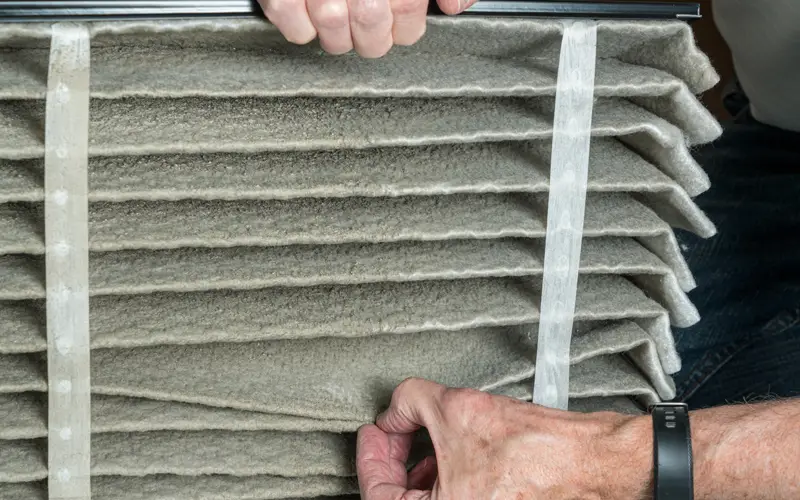
Your filter looks gray instead of white

And yes, sometimes the sign is simply pulling the filter out and thinking, “Yikes.”
The Best Way to Figure Out Your HVAC Filter Schedule
When you move into a new home—or when your household changes—the best thing you can do is test and adjust.
Here’s what we recommend:
- Start with the standard timeframe for your filter size
- Check it every 30 days at the beginning
- If it still looks clean, great, stretch the time
- If it looks dirty early, shorten the interval
No complicated math. No spreadsheets. No overthinking it.
Your filter will tell you when it’s done. You just have to look at it.
A Quick Pro Tip from the Field
If you hold your filter up to the light and can’t see much light coming through… it’s time to replace it. Doesn’t matter what the calendar says.And if you’re not sure what size filter you need, how often you should be changing it, or whether your system is breathing like it should—yeah, that’s what we’re here for. New Era’s happy to take a look—no filter math degree required.